Ask any board chair, charity trustee, or product lead whether their organization takes good minutes, and you will usually get a thoughtful pause followed by a hedged answer. Everyone agrees minutes matter. Almost nobody believes their own practice is as consistent as it should be.
The reason is rarely a lack of knowledge. Most people who run meetings could describe what good minutes look like if you asked them. They would mention attendance, decisions, action items, owners, dates. The gap between that description and the document that actually gets written (or does not get written) is a behavioral one. It comes down to habits, rituals, and the small friction points that quietly erode discipline over time.
This post is a practical guide to closing that gap. It assumes you already understand why minutes matter. The goal here is to help you build a practice that holds up across dozens of meetings, a revolving cast of participants, and the pressure of whatever else your organization has going on.
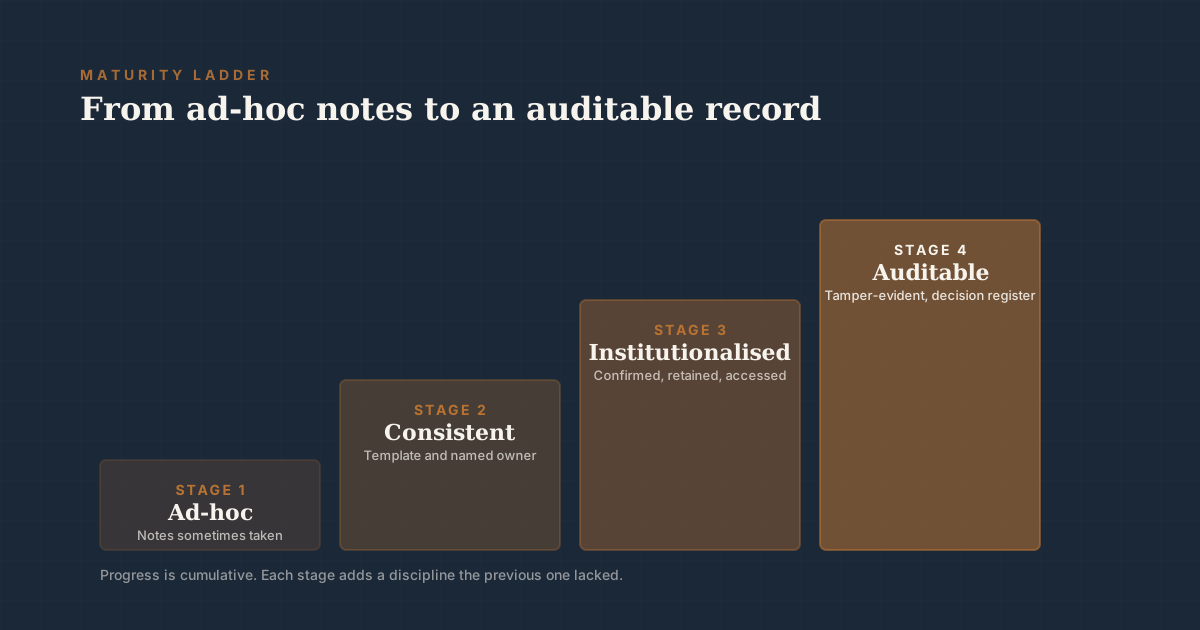
Assign Minute-Taking Before the Meeting, Not During It
The first thing to get right is ownership. In most rooms, the question of who will take minutes arrives in the first thirty seconds of the meeting. The chair looks around hopefully. Eyes drop. Someone, usually the newest or most junior person present, volunteers or is volunteered. The minutes they produce will reflect exactly the amount of preparation that decision received: none.
A minute-taker who knows three days in advance that the job is theirs is a different animal. They can read the papers properly. They can prepare a template with the agenda items already laid out. They can think about how to frame decisions they anticipate being made. They can pace themselves during the meeting because they are not also learning the context as they go.
Assign the minute-taker when you send the calendar invite, not when you open the meeting. Put their name on the agenda. Make it a named responsibility, not an ambient one.
For standing committees, this is easily handled by rotation. Many trustee boards rotate minute-taking duty among members, with the chair keeping a simple roster. For product teams, a pattern that works well is pairing the role with meeting facilitation: whoever runs the retro for the sprint also owns the write-up. For executive and leadership syncs, a dedicated secretary or chief of staff is often the right answer. What matters less is which model you choose; what matters is that the role is named, expected, and understood before the meeting starts.
The facilitator-scribe split
For meetings where decisions genuinely matter (board meetings, AGMs, strategy reviews, anything regulated) consider separating the roles of facilitator and scribe entirely. Someone chairs. Someone else writes. The scribe does not have to contribute to the discussion unless something needs clarification for the record. In practice this is one of the cheapest ways to improve minute quality at a stroke, and most organizations already have someone in the room who could take this on without becoming a full-time commitment.
Use the Same Template Every Time
The second lever is format. Every set of minutes your organization produces should look structurally identical. Same headings, same order, same place for attendees, same convention for recording decisions, same treatment of action items. If a director reads one set of minutes they should be able to navigate any other set within three seconds.
This matters for two reasons. The first is navigability. When minutes are consistent, readers find what they need without searching. The second is more subtle: a consistent template is a scaffold for the person writing. If every meeting has a fixed shape, the minute-taker never has to decide how to lay out the document. They just fill it in. That removes a large amount of cognitive load at exactly the moment when they are also trying to follow the discussion.
- Meeting name, date, time, and location (including virtual platform)
- Present, apologies, and any declared conflicts of interest
- Minutes of the previous meeting (confirmed or amended)
- Matters arising from those minutes
- Agenda items in order, each with a short context paragraph and the decision or outcome
- Action items, owner, and due date, pulled out of the body of the minutes into a single list
- Any other business
- Date of next meeting
For the vast majority of meetings, that skeleton will not change from one week to the next. Keep it stable. Do not let each minute-taker reinvent it. If you have multiple committees or teams producing minutes, consider a single house style that flexes only where it has to. Charities with an AGM cycle, trading subsidiaries, and operational committees all benefit from a shared template with a few variant sections.
If your minute-takers are spending time deciding what shape the document should be, your template is doing too little. The template should be dull, predictable, and immediately fillable.
Make Confirmation a Standing Agenda Item
Minutes are not a record until they have been confirmed. In governance-sensitive settings this is formally understood: every board agenda begins with the approval of the previous meeting's minutes, moved, seconded, and voted on. In less formal settings this step is often skipped, and the result is a quiet weakening of the whole practice.
The fix is simple. Put confirmation on the agenda for every meeting, whatever the meeting. A fortnightly product retro can spend ninety seconds at the top confirming last time's write-up. A committee can spend five minutes. A board will usually spend a bit longer if amendments are proposed. The point is not the time spent; it is the ritual. The act of asking "does anyone disagree with the record?" reinforces, every single time, that the document is the source of truth.
There is a second benefit. When people know their draft will be read aloud or discussed at the next meeting, they write it more carefully. Accountability lives downstream of visibility.
What to do with amendments
Amendments to minutes are healthy. They are a sign the review step is working. Handle them transparently: note the proposed amendment, discuss it, agree it, and record the change in the current meeting's minutes. Do not silently rewrite the original document. The integrity of a record depends on being able to reconstruct not only what was decided, but when and how that wording came to be.
Store the Record With Retention and Access in Mind
A confirmed set of minutes is only useful if it can be retrieved years later by the right people, and not by the wrong ones. Most organizations solve the first problem adequately (a folder somewhere) and the second problem by accident. Both deserve more deliberate thought.
Retention rules vary by jurisdiction and sector. In the UK, the Companies Act requires board minutes to be kept for at least ten years, and the Charity Commission expects trustee minutes to be retained permanently. In the US, the Revised Model Business Corporation Act requires corporations to maintain minutes, the IRS expects 501(c)(3) organizations to retain board minutes as part of their governance records, and ERISA imposes specific retention requirements for pension plan fiduciaries. Regulators on both sides of the Atlantic — the Information Commissioner's Office in the UK, NARA and sector-specific regulators like the SEC and FINRA in the US — publish detailed retention guidance. If you do not know your retention obligations off the top of your head, that is the first thing to find out.
Access is the flip side of retention. Minutes of a remuneration committee, for example, should not be on the same open share as minutes of a weekly all-hands. A well-run record system separates meeting types, limits access to those with a legitimate need, and logs who looked at what. This is not theatre. When a regulator or auditor arrives, the quality of your access log becomes part of the evidence that your governance is serious.
A filing system with who can see what, for how long, and what was viewed is a governance tool. A folder called `meetings-2025` on a shared drive is not.
The Decision Register as a Mature Practice
Organizations that have mastered the basics almost always reach for one further tool: the decision register. Minutes capture the full narrative of a meeting. A decision register strips out everything except the decisions themselves, indexed chronologically, each one cross-referenced to the meeting, date, and people present.
The register answers one specific question very quickly: when did we decide this, and who was in the room? That question arrives more often than most teams expect. A new CFO wants to understand the history of a reserves policy. A successor trustee needs to trace the evolution of an investment mandate. A product team is revisiting a customer commitment made eighteen months ago. Without a register, each of those queries becomes an afternoon of email archaeology. With one, they are a two-minute lookup.
A good register is short, structured, and boring. Every row is a decision. Every row includes the decision text, the date, the meeting, the attendees, and a link back to the minutes where the full context lives. Nothing more is needed. Keep it simple and it will actually be maintained; add fields and it will quietly fall out of use.
How Tooling Closes the Intention-Action Gap
Everything above is process. None of it strictly requires software. Organizations have produced excellent minutes with pen and paper for centuries, and some still do. But software, used well, removes a set of specific friction points that erode practice in ways most teams do not notice until they have gone.
Recording removes the participation penalty
The single hardest thing about taking minutes is doing it while also being present in the conversation. A recording lifts that burden. The minute-taker can engage properly, knowing they can check specific points after the meeting. This is particularly useful for the facilitator-scribe split described earlier: a scribe with a recording to fall back on produces noticeably better minutes than one working from memory alone.
AI drafting removes the blank-page tax
A structured first draft, generated from the recording and the agenda, turns minute-writing from a creative task into an editing task. Editing is faster, less intimidating, and less likely to be postponed. The 24-hour distribution window, which historically collapsed under the weight of people's other commitments, becomes realistic again. The draft is never the final record; it is a starting point that respects the minute-taker's time.
Structured workflows remove the approval drift
A system that tracks a minute-set through draft, review, amendment, and confirmation, with each step logged, prevents the quiet erosion that happens when confirmation slips off the next agenda. When the confirmation step is built into the tool, and the record only becomes final once the chair has signed it off, the ritual is enforced by the platform rather than by memory.
Tools do not replace practice. They protect it from the small, everyday forces (forgetfulness, competing priorities, rushed meetings) that gradually unpick even well-designed processes.
Building an Accountability Culture Through Documentation Habits
There is a broader point worth drawing out. The specific habits described here (named owners, consistent templates, standing confirmation, retention rules, decision registers) do more than produce better documents. They shape how an organization thinks about its own commitments.
Teams that keep good minutes tend to keep their word more consistently. Not because minutes magically create integrity, but because the practice of writing decisions down, naming owners, and reviewing commitments at the next meeting makes drift visible. You cannot quietly let an action item slip when its owner's name is on page three of a document that everyone will read next fortnight. That visibility compounds. Over months and years, it becomes the default expectation that commitments are honored, and that honoring them is the whole point of the meeting.
This is why the investment in minute-taking practice pays back out of proportion to the time it costs. A charity board that confirms minutes properly is, almost without realising it, also becoming a board that holds itself to its decisions. A product team that keeps a decision register is a team that stops re-litigating the same questions every quarter. The documentation is the scaffolding; the culture grows on it.
Where to Start
If your organization is not yet here, pick one meeting. Just one. A recurring one with stakes attached: a trustee meeting, a fortnightly exec sync, a product steering group. Apply the full set:
- Name the minute-taker in the calendar invite for the next three meetings in advance
- Agree a single template and commit to using it every time
- Put minute confirmation as item one on the agenda, without exception
- Define a retention period and a location that reflects it
- Start a decision register with one row per confirmed decision
Within three meetings, the practice starts to feel normal. Within ten, it becomes the baseline against which exceptions are judged. Within a year, it is part of how your organization works, and people who join inherit the habit without having to be taught it explicitly.
The difference between organizations that govern themselves well and those that do not is rarely about talent or intent. It is about whether the small, repeatable practices are in place and enforced. Minute-taking is the most visible of those practices. Get it right, and a great deal else follows.
Where ācta Removes the Friction
The friction points that erode consistency are well-documented here: the blank page, the approval that slips off the next agenda, the decision register that nobody maintains. ācta addresses each one directly. AI drafting from the recording eliminates the blank page. Built-in templates mean there is nothing to design. The structured approval workflow — draft, review, chair sign-off — creates the confirmation ritual automatically, without relying on anyone to remember to add it to the agenda. And the decision register maintains itself: every locked set of minutes feeds it.
The result is a practice that does not depend on discipline alone. The platform holds the shape when memory and competing priorities try to erode it.
The goal is not perfect minutes. The goal is a practice so consistent that when you ask "what did we decide?" the answer is always in the same place, in the same format, confirmed by the same ritual.