Ask a board secretary what meeting minutes are for and they will say compliance. Ask a lawyer and they will say evidence. Ask a product manager and they will say a reminder of what got agreed. All of those answers are right in their narrow sense. All of them miss the thing that actually matters.
Meeting minutes are accountability infrastructure. They are the mechanism by which a conversation becomes a commitment, a commitment becomes a trackable action, and an action becomes organizational memory that outlasts the people who made the original decision. When that infrastructure is working, an organization can tell you who decided what, when, and on what basis. When it is not, disputes are settled by whoever has the loudest voice or the longest memory.
This piece is about why that matters more than almost anyone in the meeting believes it does, and why the failure modes are expensive in ways that do not show up until it is far too late to fix them.
Decisions Are Only Binding If They Are Recorded
There is a peculiar moment that happens in unstructured meetings. Someone proposes an option. Heads nod. The conversation moves on. Three weeks later half the room believes the option was adopted and the other half believes it was tabled for further discussion. Nobody is lying. The meeting simply ended without a recorded decision, and human memory is an unreliable shared artifact.
A decision becomes binding at the moment it is written down, reviewed, and confirmed. Everything before that is a proposal. That is not a semantic distinction. It is the reason that corporate statutes — the Companies Act 2006 (section 248) in the UK, state corporate codes and the Revised Model Business Corporation Act in the US — require directors' meeting minutes to be retained, why charity regulators and the IRS expect governing boards to document their deliberations, and why employment tribunals and courts ask for contemporaneous minutes rather than later recollections.
A decision without a record is a suggestion. A decision with a record is a commitment.
Treat this as a working principle rather than a slogan. If the board decides to change a policy and the minute reads "discussed the policy change," nothing has happened. If it reads "resolved that the refund window is extended to 30 days with effect from 1 May, proposed by J. Park, carried unanimously," then something exists that can be audited, enforced, appealed, or later amended through a formal process. The language matters. The record is the decision.
Organizational Memory Does Not Live in People
There is a comforting myth that the memory of an organization lives in its long-serving staff. In practice it lives in three places: contracts, documentation, and the tribal knowledge of whoever happens to still be there this quarter. The first two are durable. The third is the one everyone relies on, right up until the day someone leaves.
A colleague who has been at an organization for twelve years can tell you why a process works the way it does. A minute from 2019 can also tell you why. The difference is that the minute does not have a notice period.
This matters more with each passing year, because the average tenure at most knowledge-work organizations is shortening. LinkedIn's Workforce Insights, the US Bureau of Labor Statistics, and the UK Office for National Statistics all track declining median tenure in professional services and technology sectors. In that environment, undocumented decisions are decisions on rental. They expire when the people who made them walk out of the building.
The strongest organizations I have worked with all share one habit: they write things down in a way that a new arrival three years from now will still be able to follow.
— Sarah Drasner, on engineering leadership
Minutes are the cheapest and most durable form of organizational memory available. A properly structured set of minutes, stored in a system with retention and access controls, will still answer the question "why did we decide that?" long after everyone present has moved on. No other artifact does that job as consistently.
Value at Every Scale
One of the reasons minutes get dismissed as bureaucracy is that the loudest advocates for them tend to work in regulated, board-level environments. That framing makes them sound like something that concerns the top 1% of an organization's meetings and nobody else. It is exactly backwards. The governance value of minutes scales down just as well as it scales up.
Board and trustee level
At the top of the scale, the minutes are the legal record. Board resolutions, fiduciary votes, conflicts of interest declared, risks accepted. These records are examined by auditors, regulators, acquirers, and occasionally by courts. Nothing controversial about taking them seriously here. The infrastructure is mature, the formats are conventional, the retention periods are statutory.
Committee and operational level
One step down, minutes become the working tissue of an organization. An ops committee agrees a change to a supplier contract. A safeguarding committee decides to escalate a case. A pricing committee approves a discount framework. None of these are board-level events, but all of them create obligations that need to be trackable. Minutes here are not about compliance. They are about the next meeting being able to pick up where this one left off.
Team and project level
Further down still, a product team runs a weekly prioritization meeting. They decide which two bugs to ship, which to defer, and who owns the next customer interview. No regulator cares. But a month later someone asks why a specific bug was deferred, and the answer lives in that meeting. Minutes at this level do not need to look like board minutes. They need to capture the decisions, the owners, and the next review date. The format is different. The purpose is the same.
Daily standups and one-to-ones
At the bottom of the scale, a fifteen-minute standup still produces commitments. "I will look into that by tomorrow" is a decision. If it is not captured anywhere, it becomes one of the quiet sources of friction that erodes trust in a team. Nobody wants to take verbose minutes of a standup. Nobody should. But three bullet points pasted into a channel at the end of the meeting is not overhead. It is the same mechanism operating at the smallest useful unit.
A PM tracking commitments from a daily sync needs the same clarity as a board secretary documenting a fiduciary vote. Different scale, same infrastructure.
Distributed Teams Break Ambient Memory
Much of what passed for meeting documentation in co-located organizations was never really documentation. It was ambient. People walked out of the room together, chatted about what had just been agreed, reinforced their understanding over coffee, and ran into the absent colleague at lunch to give them the gist. The shared physical experience did most of the work that minutes are supposed to do.
That stopped being true for most knowledge work around 2020 and has not come back. In a distributed team, half the board joins by video call and the other half are in the room, or nobody is in the room at all. There is no coffee queue. There is no accidental reinforcement. The only canonical record of what happened is whatever is written down and shared afterwards. If that artifact is weak, absent, or delayed, the meeting effectively did not happen for everyone who was not paying close attention at the time.
Organizations that have adapted well to distributed work tend to over-document relative to their pre-2020 practice. That is not a workaround. It is the correct response to losing a channel that used to carry a lot of information for free.
The Decision Register: Minutes Compounded
Minutes tell you what happened in a single meeting. A decision register tells you what the organization has decided, full stop. It is a continuously updated, searchable record of every material decision, cross-referenced back to the meeting where it was made and the people who were present.
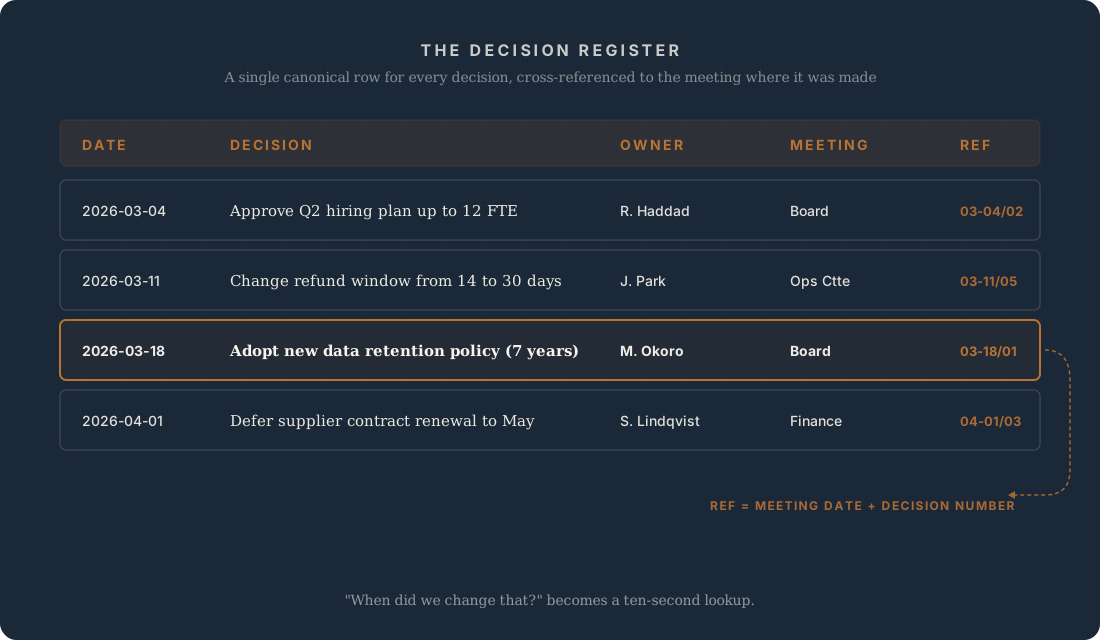
The format is almost comically simple. A table. One row per decision. Columns for the date, the decision in a single sentence, the owner, the meeting, and a short reference code that points back to the minute where the decision lives. That is it. Nothing about this requires specialist software. A spreadsheet works. A well-structured wiki page works. An internal tool backed by a database works better once you outgrow the spreadsheet.
The value is in what a decision register makes easy that would otherwise take days. Questions like "when did we change the refund policy?" or "who approved the current data retention period?" or "what did the board decide about the office lease?" go from email archaeology, Slack scrollback, and calendar-crawling to a ten-second lookup. Over the course of a year, the time saved is material. Over the course of five years, it is the difference between an organization that knows itself and one that is perpetually rediscovering its own decisions.
Why nobody maintains one
If decision registers are so useful, why are they rare? The honest answer is that they fall into the category of work that has compounding returns but almost no short-term reward. Maintaining the register takes ten minutes after each meeting. The first time someone needs to look up a historical decision, they save an afternoon. But the causal connection between those two events is invisible at the moment of writing. The effort looks pointless until the day it does not.
Organizations that manage to maintain a decision register generally have one person whose job explicitly includes it. That person is usually a company secretary, a chief of staff, or a governance-focused operations lead. The register is a standing item on the meeting agenda rather than a nice-to-have. When the ownership is fuzzy, the register dies within a quarter.
What Absence Looks Like
Every story about the cost of poor minute-taking sounds like a lawyer's horror story, and it is usually told in the abstract because the real examples are confidential. A few concrete patterns are common enough to describe without identifying anyone.
The policy nobody remembers approving
A customer complains that a fee was wrongly applied. An internal investigation shows that the fee schedule was updated eighteen months ago. Nobody can find the meeting where it was approved. There are two emails, one Slack thread, and a modified spreadsheet in a shared drive. The organization either refunds defensively across hundreds of affected customers or tries to argue in front of a regulator that an approval happened despite the absence of any record. Both outcomes are expensive.
The tribunal that turns on a minute
An employee is dismissed after a performance management process. They take the case to tribunal or court and claim the process was arbitrary. The employer's evidence is a sequence of one-to-one meetings where concerns were raised and improvement plans agreed. If those meetings were minuted contemporaneously, signed by both parties, and retained, the employer has a defensible case. If the evidence is a reconstructed timeline written by a manager six months after the fact, the employer does not. Employment tribunal statistics from HM Courts and Tribunals Service and wrongful-termination case data from the EEOC and US federal courts consistently show that the strength of contemporaneous documentation is one of the largest single predictors of case outcome.
The charity audit that finds nothing
A small charity is subject to a statutory audit. The trustees have made sensible decisions throughout the year. Their meetings happened. Their judgements were reasonable. But the minutes are sparse, inconsistent, and in some cases missing entirely. The auditor does not claim wrongdoing. They simply record that governance documentation is inadequate. That finding will appear in the published accounts, will be read by the Charity Commission in the UK or surface through IRS scrutiny and state attorney-general oversight in the US, and will be seen by major funders and anyone doing due diligence on the organization. The reputational cost is disproportionate to the actual failure, because from the outside it is indistinguishable from a governance problem.
In each of these patterns, the thing that was lacking was not judgement. It was the record of judgement. That distinction is almost impossible to explain to a regulator or a court.
Infrastructure, Not Overhead
The mental shift that makes minute-taking work is a framing shift. A team that treats minutes as overhead will optimise for the lowest defensible effort. A team that treats minutes as infrastructure will invest in the tools, the templates, the review cycles, and the people whose job it is to maintain them.
The return on that investment is not obvious in the first quarter. It is large and cumulative over any time horizon longer than a year. Organizations that take this seriously spend less time arguing about what was decided, onboard new members more quickly, defend themselves more successfully when disputes arise, and make better forward decisions because they can see their own track record. None of that is speculative. It is the observable difference between organizations that know themselves and organizations that do not.
What That Infrastructure Looks Like in Practice
ācta provides the infrastructure this piece describes. Meetings are recorded natively — no bot, no third-party audio access. The recording produces a structured draft: decisions stated clearly, action items named, attendance logged. The chair reviews and formally approves it. Approval locks the record with a SHA-256 hash seal; the document is now tamper-evident. A hash-sealed PDF with the full approval history goes out to all recipients in one step, and acknowledgement is tracked without requiring anyone to create an account.
Every approved decision is automatically indexed into a cross-meeting decision register. The question "who approved the current data retention period?" resolves in seconds, not an afternoon. That is the register that most governance-focused organizations know they should maintain but consistently fail to. ācta makes it a byproduct of the minutes workflow rather than a separate task requiring a dedicated owner.
The question to sit with is not "do we take minutes?" It is: could you produce, within ten minutes, an authoritative answer to a question about a decision your organization made three years ago? If the answer is no, the gap is not the tools. It is the infrastructure.