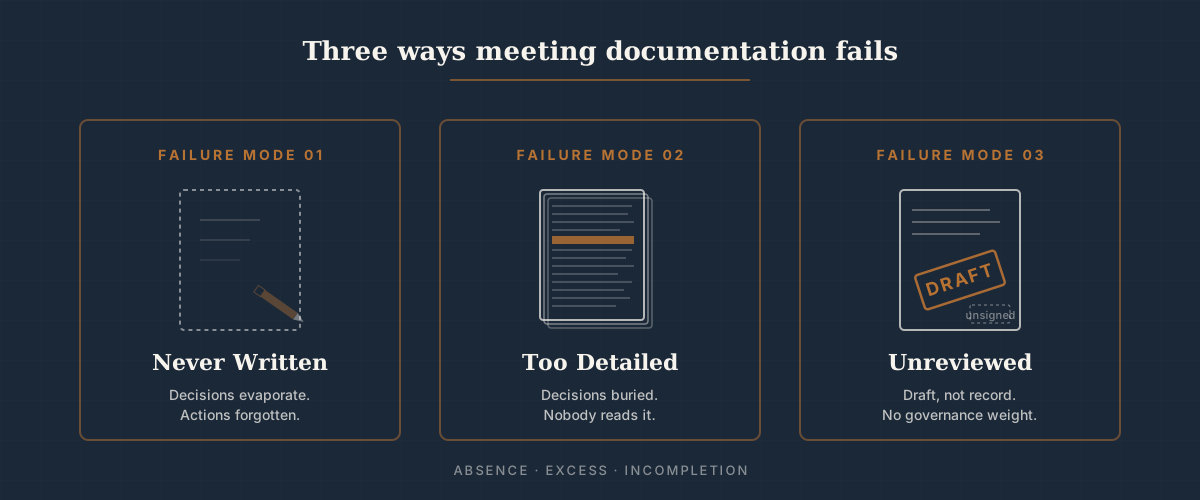
Meeting documentation fails in predictable ways. After sitting through enough board reviews, trustee meetings, and leadership syncs, the failures start to look less like accidents and more like systems producing the results they were designed to produce. A team without a documented process for capturing and confirming minutes will, reliably, produce one of three outcomes: no record, an unreadable record, or an unconfirmed draft that never becomes a record at all.
Each failure has a different cause, a different downstream cost, and a different fix. The point of naming them is not to moralise about bad practice. It is to make the pattern legible so that a team can see which failure mode they are drifting into and intervene before it becomes habit.
Failure Mode One: Minutes That Are Never Written
The most common failure is also the most invisible. Someone takes notes during the meeting, the meeting ends, everyone moves on to the next thing in the calendar, and the notes sit in a notebook or a personal Google Doc that nobody else ever sees. A fortnight later the secretary has left on vacation, the laptop is locked, and the decisions have evaporated with the person who remembered them.
The visible cost is that action items do not get done. The invisible cost is worse: the same discussion happens again three months later, with the same people reaching the same conclusion, unaware that the last version of this conversation ever occurred. Organizations with weak documentation habits spend a shocking amount of time re-litigating decisions they already made.
A decision that is not written down is not a decision. It is a temporary consensus that will expire the moment someone's memory of it conflicts with someone else's.
This failure mode is especially damaging in governance-heavy contexts. Consider a charity trustee board that reaches an informal agreement about a restricted fund transfer. No one minutes it. Six months later, the Charity Commission opens an inquiry into how the funds were used. The trustees remember the conversation but cannot point to any record of the authorization. They are now personally liable for a decision they genuinely believe the board approved, and they have no evidence to support that belief. This is not a theoretical risk. It is the standard shape of trustee disputes that end in regulatory action.
The same failure shows up in commercial contexts. Employment tribunals routinely hinge on whether a performance concern was raised formally or in passing. A manager who says "we discussed this in the team meeting" and cannot produce the minute of it is in a much weaker position than one who can.
Why it happens
Minutes do not get written for two reasons, and both are process failures rather than character flaws. First, nobody is explicitly responsible. When minute-taking is a vague expectation rather than an assigned role, it defaults to whoever feels guiltiest, or to nobody. Second, the format is too heavy. If producing minutes means a two-hour writeup after a one-hour meeting, a rational person will avoid the task until they can do it properly, which turns out to be never.
The fix
Assign a named minute-taker before the meeting, every time. Rotate the role if it helps. Use a short, consistent template so that the writeup is mostly filling in blanks, not composing prose. Record the audio as a safety net, but do not rely on the audio as the record. The record is the written minute, confirmed by the chair, shared with the attendees within a defined window. The audio exists so that the minute-taker can check a detail without having to remember everything.
Failure Mode Two: Minutes That Are Too Detailed
The overcorrection to absent minutes is verbatim minutes. Someone, traumatised by a past dispute, starts capturing everything. Every remark, every digression, every parenthetical aside. The meeting that lasted ninety minutes becomes a thirty-page document. The document lands in inboxes, where it is scanned, scrolled past, and filed unread.
This is not a harmless failure. A document that nobody reads is worse than no document, because it creates the illusion of accountability without any of the substance. The decisions are technically captured, somewhere, inside the wall of text. But nobody can find them. Nobody is going to scroll through twenty-eight pages to locate the one sentence where the budget was approved. The decisions are in the record and simultaneously lost.
A minute is not a transcript. A minute is a summary of what the organization decided. Everything else is exhibit material, not record.
Verbatim minutes also introduce a subtler problem: they become political artifacts. When every comment is captured, attendees start worrying about how their contributions will read when quoted back months later. Discussion becomes guarded. People stop challenging weak proposals because they know the challenge will live forever in the record. The meeting is poorer for it, and ironically the quality of decisions declines.
NHS governance committees, before the modernization of board reporting, were notorious for this. Minutes ran to dozens of pages because nobody trusted summaries to capture the nuance. The result was that key decisions about patient safety sometimes sat buried in paragraph forty-two of a document that only one or two members had time to read in full. After a string of inquiries recommended structured, summarised minutes with decisions called out explicitly, the format moved closer to what good governance always required: the essential facts, clearly presented, and nothing else. US hospital governance saw similar reforms after the Joint Commission tightened board reporting requirements.
Why it happens
Over-detailed minutes are usually a reaction to a past failure. The organization got burned once, by a disputed decision or a trustee who denied saying what they said, and the response was to capture everything from then on. The capture becomes its own end. The value of the minutes, their usefulness as a governance tool, is sacrificed to the defensive reflex of the minute-taker.
AI transcription has made this failure mode more common, not less. The temptation to paste an automated transcript into the minutes and call it done is strong. The result is exactly the document nobody wanted: long, contextless, and full of misheard names.
The fix
Treat structure as non-negotiable. Every minute should be built around a fixed set of headings: attendees, decisions, actions, items deferred. Anything that does not fit under those headings does not belong in the minutes. Narrative belongs in a separate appendix, or, more often, nowhere at all. Train whoever writes the minutes to ask one question of every paragraph: does a non-attendee need this to understand what we decided? If not, cut it.
The test of a good minute is not how much it captures. It is how quickly someone who missed the meeting can locate the decision that affects them.
Failure Mode Three: Minutes That Go Unreviewed
The third failure is the most common in well-intentioned organizations, and the most corrosive. Minutes get written. They get distributed. Then nothing happens. No formal review, no confirmation at the next meeting, no signature from the chair. The draft sits in a folder, read by few, approved by none, disputed later by anyone who finds it inconvenient.
This is the governance version of a payment that was sent but never reconciled. The transaction technically occurred, but it has no weight. A draft minute is not a record. It cannot be cited in a dispute. It cannot satisfy a regulator. It cannot defend a trustee against a claim of mismanagement. Until the minutes are confirmed, by the people who were in the room, the meeting has no binding documentation of what was decided.
Pension trustee failures regularly turn on this distinction. A scheme holds a meeting, decisions are made about investment strategy or member communications, and the secretary circulates a draft minute. Nobody reviews it properly. At the next meeting the review step is skipped because the agenda is full. The draft becomes the permanent record by default, without ever being confirmed. When the Pensions Regulator audits the scheme years later, the trustees discover that their record of authorization is a draft that was never approved. The scheme's position is weaker for it, and in some cases the trustees face personal consequences. In the US, the Department of Labor enforces comparable requirements for ERISA-governed pension plans, and the consequences for trustees are equally personal.
Draft versus record
The distinction between draft and record is the single most underappreciated concept in meeting governance. A draft is a proposal. A record is what the organization accepts as its official account. The transition from one to the other is not cosmetic. It is the moment that turns a private note into a binding document. Without that transition, everything sits in a permanent gray zone.
The governance weight of confirmation is real. In most formal settings, including company boards under the Companies Act in the UK (and state corporate codes in the US), and charity trustees under Charity Commission guidance (or IRS governance expectations for 501(c)(3) organizations), minutes only become the official record of the meeting once they have been formally approved at a subsequent meeting. This is not a ceremonial step. It is the mechanism by which the organization ratifies its own account of what it decided.
The fix
Make confirmation a standing agenda item. The first item of every meeting should be approval of the previous meeting's minutes. No other structural change has a larger effect on the quality of an organization's governance record. Once confirmation becomes habitual, the minute-taker has a deadline and the attendees have a reason to read the draft. The review becomes the forcing function that turns documentation into record.
The 24-Hour Rule
Across all three failure modes, one factor compounds the damage: delay. The longer the gap between the meeting and the draft, the less accurate the draft, the less engaged the reviewers, and the less likely the confirmation step ever happens.
The 24-hour rule is a rough heuristic that most effective governance bodies converge on: draft minutes should be circulated within a day of the meeting. Not because a day is magically enough time to produce perfect prose, but because a day is the window in which memory is still fresh, attendees are still thinking about the meeting, and corrections can be made while the conversation is reconstructable.
Beyond twenty-four hours, a different dynamic takes over. The meeting recedes. Other priorities crowd in. The minute-taker, who has now had two more meetings and a long Tuesday, struggles to remember whether the decision about vendor selection was qualified or unconditional. Attendees, asked to review a draft a week later, skim it, notice nothing obviously wrong, and approve it by default. The record that gets locked in is the one the minute-taker managed to reconstruct from fading memory, not the one that actually reflects the meeting.
Speed in minute-taking is not about efficiency. It is about fidelity. A draft written within a day is a draft anchored to the meeting. A draft written a week later is a draft anchored to the minute-taker's reconstruction of the meeting.
The Participant-Scribe Problem
All three failure modes are exacerbated by a structural problem that every working meeting encounters: the person taking the minutes is usually also a participant. Often a senior one. Trying to contribute to a discussion while simultaneously summarising it in writing is a genuinely difficult cognitive task. Something has to give. Either the contributions suffer, or the minutes do.
In larger organizations this is solved by bringing in a dedicated clerk or company secretary whose only job is to minute the meeting. This works, but it is expensive and it does not scale to the dozens of smaller meetings where governance still matters: project steering committees, subcommittees, working groups, team reviews. Most meetings that produce important decisions do not have a professional minute-taker. They have a participant who is also trying to record what everyone else is saying.
This is the problem that audio recording plus structured drafting is genuinely useful for. Not because a transcript is a minute (it is not), but because it removes the real-time capture pressure. The minute-taker can participate fully, knowing that the meeting is recorded and that the detail will still be there when they sit down to draft. The draft is produced after the meeting from a combination of notes, recording, and structured template. It is not an automated summary. It is a human judgement about what the meeting decided, supported by a reliable source.
Patterns That Prevent All Three
None of these failure modes are solved by exhortation. Telling people to write better minutes does not work. What works is a small set of process patterns that make the failures structurally unlikely.
- Assign the minute-taker in the calendar invite, not on the day. Role ambiguity is the root cause of absent minutes.
- Use a fixed template with four sections: attendees, decisions, actions, next meeting. If a paragraph does not fit under one of those, it does not belong in the minutes.
- Record audio as a safety net, not a substitute. The record is the confirmed written minute.
- Circulate the draft within twenty-four hours of the meeting. Build this into the minute-taker's calendar as an explicit block of time.
- Put confirmation of previous minutes as the first item on every agenda. Do not skip it, even when the agenda is full.
- Once confirmed, lock the record. If an amendment is needed, it goes through a formal correction at a subsequent meeting and is appended, not overwritten.
None of these patterns are novel. Most of them come directly from centuries of practice in board governance, refined through hard experience with disputes, inquiries, and regulatory action. What is new is that they now scale. The same discipline that a FTSE or Fortune 500 board applies to its minutes can be applied, without much additional effort, to a project steering committee or a charity subcommittee. The tools are better. The excuse that good documentation is too expensive for smaller meetings has worn thin.
Getting Out of the Failure Modes
Most organizations can identify their dominant failure mode quickly. The team whose minutes consistently fail to appear is in failure mode one. The team whose minutes run to twenty pages and whose board members quietly admit they stopped reading them is in failure mode two. The team with a folder full of unconfirmed drafts, or whose agendas never quite get around to approving last month's minutes, is in failure mode three.
The fix is rarely about trying harder. It is about changing the process so that the failure mode is structurally prevented. Assigning the minute-taker in advance prevents the first failure. A fixed template and a discipline of brevity prevents the second. A standing confirmation item on every agenda prevents the third. The twenty-four hour rule binds all three together by ensuring that the record is produced while the meeting is still reconstructable.
Good meeting documentation is not an act of heroism. It is the output of a process that has been designed to produce reliable records as its default behavior. When the process is right, the minutes write themselves, or close enough. When the process is wrong, no amount of individual effort will compensate. The three failure modes are the three ways that a broken process expresses itself. Name them, recognize them, and the remedy is usually obvious.
Structurally Preventing All Three
ācta is designed around these failure modes specifically. AI drafting addresses the first: because the recording produces a structured draft within minutes of the meeting ending, there is no longer a two-hour writeup standing between the meeting and the record. The template-driven output addresses the second: decisions, attendees, actions, and deferred items are extracted into fixed sections, so the draft cannot become a wall of prose that nobody reads. The approval workflow addresses the third: the draft is explicitly a draft until a named person formally confirms it, at which point the record is sealed and any future modification is detectable.
What matters is that none of this depends on individual discipline or someone remembering to do the right thing. The process is designed so that the failure modes are structurally blocked rather than personally resisted. That is the difference between a documentation habit that survives personnel changes and one that collapses the first time the conscientious person leaves.
If you cannot point to the confirmed record of last month's key decision, you do not have a documentation problem. You have a governance problem wearing a documentation disguise.