Most teams know they should write better minutes. Very few teams agree on what that actually means. The result is a quiet patchwork across an organization: one committee produces tidy, numbered decisions; another sends out a five-page narrative that reads like a short story; a third skips minutes entirely and hopes the Slack thread will do. Six months later, nobody can find anything.
This post is the answer to the practical question that sits underneath that mess. What does a good set of meeting minutes look like, section by section, and what habits turn them into a consistent output across every meeting in the business?
The Six Essential Elements
Every useful set of minutes contains the same six blocks. The order can vary and the formatting can flex with your template, but if any of these are missing, the record is incomplete.
- Attendees, apologies, and the chair
- Agenda items with brief context
- Decisions, stated as decisions
- Actions with named owners and due dates
- Deferrals and items carried over
- Date of the next meeting (if agreed)
Each of these blocks has a job. When one is skipped, the record gets weaker in a predictable way. Skip attendees and you lose quorum evidence. Skip owners and actions drift. Skip deferrals and the same topic reappears three meetings running with nobody quite sure why.
1. Attendees, apologies, and the chair
Start with who was in the room. Full names, not first names alone. Split into present, apologies received, and absent (no apology). Name the chair and the minute-taker explicitly. If anyone joined remotely or left partway through, note the times. For governance meetings, record whether a quorum was met before any decision is logged.
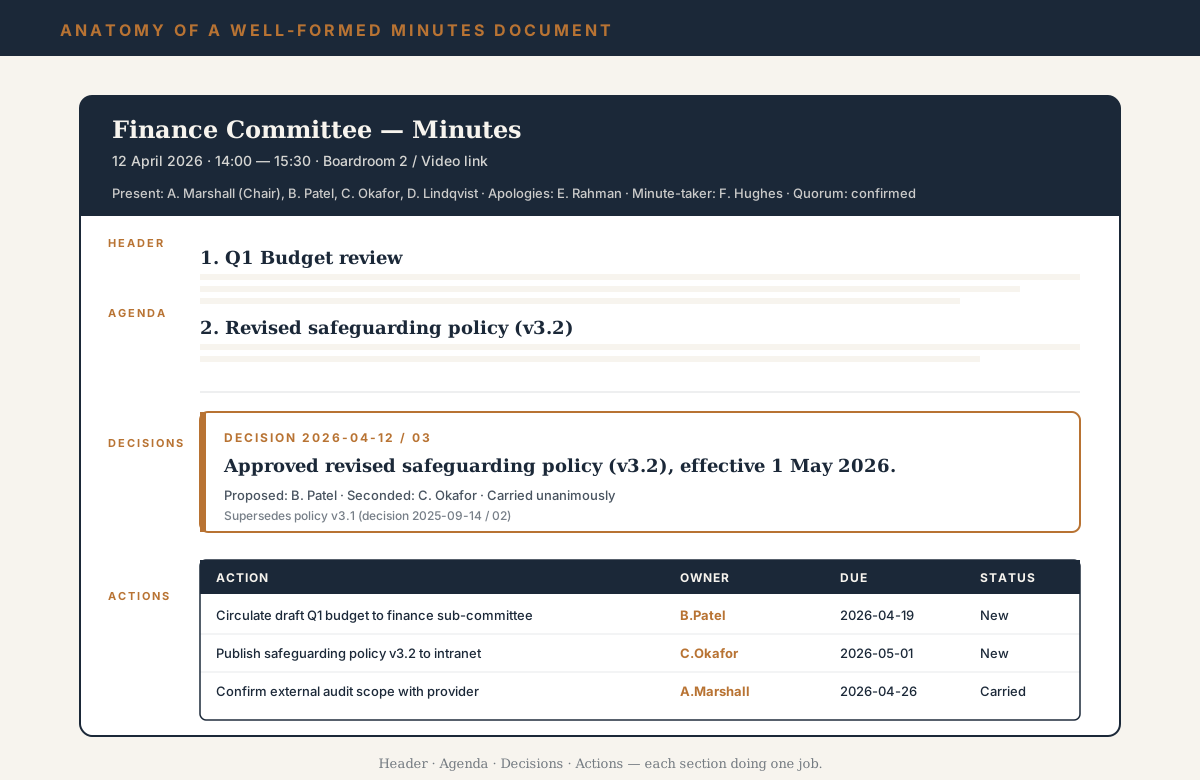
Present: A. Marshall (Chair), B. Patel, C. Okafor, D. Lindqvist. Apologies: E. Rahman. Minute-taker: F. Hughes. Quorum (4 of 5 trustees): confirmed.
2. Agenda items with brief context
Each agenda item gets a short paragraph: what was discussed, what papers were tabled, who introduced it. Aim for three or four sentences. You are not writing a novel. You are giving a future reader enough context to understand why a decision was made without replaying the entire conversation.
3. Decisions, stated as decisions
This is the single most common failure point. People write minutes that describe a discussion and leave the outcome implied. Don't. Every decision gets its own line, phrased as a decision, and labelled as such.
DECISION 2026-04-12/03: The committee approved the revised safeguarding policy (v3.2), effective 1 May 2026. Proposed: B. Patel. Seconded: C. Okafor. Carried unanimously.
A numbered decision reference (meeting date plus sequence number is a common convention) makes it trivial to cite the decision later in emails, contracts, or the decision register. If a vote was taken, record the counts. If it was by consent, say so.
4. Actions with named owners and due dates
Actions belong in a table, not prose. Every row has three mandatory fields and one optional one. The mandatory fields are action, owner, and due date. The optional field is status (carried forward from a previous meeting, new, or closed).
- Action: a concrete, verifiable task ("circulate draft budget to finance sub-committee", not "look into the budget")
- Owner: one named individual using a consistent format (Initial.Surname, e.g. B.Patel). Never assign to a team, department, or two people jointly
- Due: ISO date format (2026-05-02). Avoid "next week" or "end of month", since they age badly
- Status: New / Carried / Closed
The single-owner rule is the most important discipline in minute-taking. An action assigned to two people is an action assigned to no one. If two people genuinely need to collaborate, the minute records a single accountable owner, and the coordination is their problem.
5. Deferrals and items carried over
When the meeting runs out of time or a decision is postponed pending more information, that is itself a decision and needs recording. Include what was deferred, why, and when it will come back. This prevents the common situation where an item quietly disappears from the agenda because nobody remembered to carry it forward.
6. Next meeting
Close with the date, time, and (if known) location of the next meeting. If agenda items have already been flagged for it, list them. This is the handle that keeps the rhythm of recurring meetings intact.
What to Leave Out
Minutes are not a transcript. The temptation, particularly when you have a recording to hand, is to capture more because you can. Resist it. Dense minutes are unread minutes, and unread minutes might as well not exist.
A reliable rule: if removing a sentence does not change a reader's understanding of what was decided or what they need to do, remove it. Specifically, leave out:
- Who argued which position during debate (the outcome is what matters, not the back-and-forth)
- Tangential comments and side discussions
- Personal opinions offered in confidence
- Verbatim quotes, unless they are formally proposed motions
- Casual remarks, jokes, or social chat
- Procedural noise ("the chair called the meeting to order at 14:02" is rarely useful)
Leaving material out is not a cover-up. It is editorial judgement. The audio recording, if you kept one, is the source of truth for the conversation. The minutes are the source of truth for what was decided.
If something is genuinely contentious and needs to be on the record, capture it as a formal dissent: "D. Lindqvist requested it be noted that they voted against the motion." That is a structured, proper way to record disagreement. Free-form commentary about who said what is not.
Structuring for Scannability
The people reading your minutes next Tuesday are not going to read top to bottom. They will scan for three things: what was decided, what they personally need to do, and whether the last set of actions got closed. Structure the document so all three are answerable in under thirty seconds.
Practical patterns that work:
- Put the decisions block and the actions table above the narrative agenda section, not buried at the end
- Number everything. Decisions, actions, and agenda items all get stable references
- Use short paragraphs (three or four sentences, maximum). Walls of text defeat scanning
- Bold the name of the action owner in the actions table
- Keep a standing "matters arising" block near the top that lists the status of actions from the previous meeting
The goal is that a non-attendee can open the document, read only the first page, and know: what was decided, what they own, and what remains outstanding. If they can do that, the minutes are doing their job.
The Decision Register: A Companion Artifact
Individual sets of minutes are a snapshot. A decision register is the cumulative view: every significant decision the organization has taken, in a single searchable table, cross-referenced back to the minutes it came from.
A minimal register has these columns:
- Decision reference (e.g. 2026-04-12/03)
- Date decided
- Body that decided it (board, committee, exec team)
- One-line summary of the decision
- Status (active, superseded, rescinded)
- Link back to the source minutes
Populating the register takes perhaps ten minutes per meeting. The return shows up the first time someone asks "when did we change the refund policy?" and the answer is a lookup rather than an archaeology project. Over years, the register becomes one of the most valuable documents in the organization.
Templates and Consistent Formatting
Everything above is advice. Templates are how you turn advice into a habit. Without a shared template, every minute-taker reinvents the structure, and you end up with the patchwork from the opening paragraph.
A working template defines:
- Section order and headings, fixed (not suggested)
- The decision reference format (year-month-day/sequence is durable and sortable)
- The owner name format (Initial.Surname)
- The date format (ISO 8601, always)
- Where the actions table sits in the document
- The review cadence (typically: draft within 24 hours, confirmed at the next meeting)
One template per meeting type is fine. A board template, a project-review template, a standup template. What you want to avoid is one template per minute-taker, which is what happens by default.
The test for a template is simple. Hand it to someone who has never attended that meeting. Can they produce minutes that look like every other set? If yes, your template is doing its job. If not, tighten it.
How Recording and AI Drafting Change the Workflow
The minute-taker has always had an uncomfortable job: simultaneously participate in a meeting and write a structured account of it. For most of the last century, the only real fix was to assign the job to someone whose sole responsibility was taking notes, which is a luxury most organizations can't sustain at every meeting.
Recording the meeting and generating a first-draft set of minutes from the audio changes this. The minute-taker is freed to participate. The draft arrives, structured to the template, within minutes of the meeting ending. The human job shifts from capture to curation.
That shift is real, but it does not remove the governance step. An AI-generated draft is still a draft. It needs to be read, corrected where it has mishandled context, approved by the chair, and confirmed at the next meeting. The tools accelerate the work that used to take hours, but they do not replace the human accountability for what the final record says.
A workflow that works well in practice:
- Record the meeting with participants' consent
- Generate a draft using a template-aware tool, within hours
- Minute-taker reviews the draft: fixes errors, tightens language, adds context the AI missed
- Chair reviews and signs off on the draft
- Draft circulated to attendees with a deadline for correction requests
- Minutes confirmed at the next meeting and locked
- Decision register updated
Every step is still there. The recording and AI draft compress steps 1 and 2 from hours of work into minutes. That is the substantive change, and it is enough to make the difference between a team that produces minutes reliably and one that produces them when they find the time.
Bringing It Together
A good set of minutes is not hard to produce once you know what it looks like. Six sections, a decision block that labels decisions as decisions, an actions table with single owners and ISO dates, a companion register that makes the historical record searchable, and a template that everyone uses. None of this is exotic. It is just discipline.
The benefit compounds quietly. Over a year, an organization that keeps good minutes has a clean decision history, a followed-through action log, and a governance record that holds up under scrutiny. The organization that doesn't has a folder of half-finished documents and a culture of quietly relitigating the same decisions every few months.
How ācta Puts This Into Practice
ācta's built-in templates encode exactly the six elements described above. When an AI draft arrives from a recording, it is already structured: decisions are labeled as decisions, action items are extracted with named owners and ISO due dates, and the decision register is populated automatically from every locked set of minutes. The minute-taker's job is curation, not construction.
The structure is not optional and not reinventable. Every meeting type gets a template that fixes the section order, the decision reference format, and the actions table layout. That consistency is what turns a one-off discipline into an organizational habit — and what makes any single set of minutes legible to someone who was not in the room.
Good minutes are boring to write and boring to read. That is the point. The excitement lives in the meeting. The minutes exist so that excitement becomes a decision, an owner, a date, and a record.